

Arup Cellbond Barrier Models Advanced Chinese Mobile Deformable Barrier (AC-MDB)
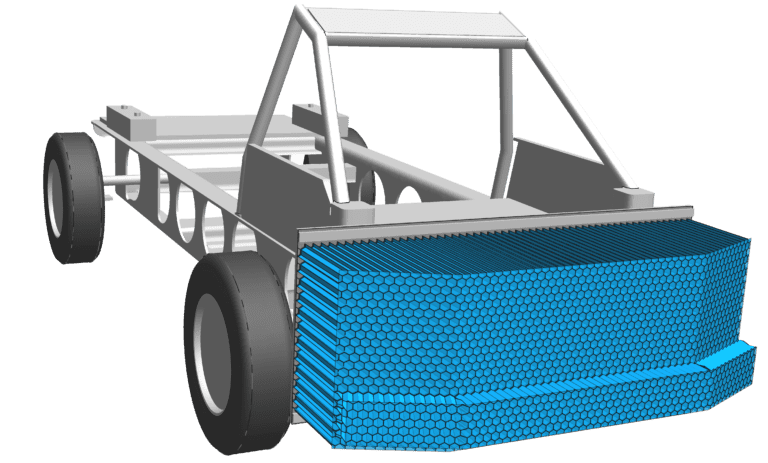
Arup-Cellbond Advanced Chinese Mobile Deformable Barrier (AC-MDB) For C-IASI 2023 side impact crashworthiness evaluations This barrier model is a Shell…
Please enter your login details below.
Please enter your your details to create a new account.
Please enter your email address to reset your password.
Please enter your email address to migrate your account.
A range of robustly validated finite element models for LS-DYNA, Arup Cellbond Barrier Models are backed by over 20 years of barrier development expertise and validated against full-scale vehicle tests to deliver simulations you can trust.
This new specification barrier model has been developed as a Shell element model which provides a more accurate representation of the physical model. All information on this page relates to this new specification Shell element model.
The previous specification model (Solid element type and version 1.0) is still available. Please get in touch for more information.
The specifications used for the development of the IIHS Side Impact Moving Deformable (MDB) Barrier 2.0 Specification described here have been taken from ‘Side Impact Crashworthiness Evaluation Deformable Barrier 2.0 Specification’, Version II, October 2022 and ‘Side Impact Crashworthiness Evaluation 2.0 Crash Test Protocol’, Version III, May 2025.
This moving barrier replaces the previous IIHS Side Impact Barrier developed back in 2000-2001. IIHS is now upgrading their side impact test protocol to include an updated deformable barrier (Specification 2.0) and a test setup that continues to reflect changes in vehicle types and accidents.
This new Specification 2.0 barrier has been redesigned to better represent the front-end shape of certain types of vehicles, SUVs and Pick-ups and is being introduced to make the barrier to vehicle tests more representative of real-life vehicle impacts. Planned introduction for the new test protocol is 2022.
The LS-DYNA model calibration was performed using an extensive physical test program conducted by Cellbond covering a range of global and localized loading conditions. The validation matrix includes the MDB against a rigid vertical impactor, an offset vertical impactor, and a rigid flat wall, which have historically formed the basis of MDB model correlation. To further assess barrier performance under loading conditions representative of modern vehicle architectures, two additional test configurations were introduced: a center bumper impact and an offset bumper impact. These tests were specifically developed to generate localized and eccentric loading of the deformable element assembly, enabling evaluation of honeycomb crushing, load transfer, and adhesive failure mechanisms beyond those exercised by traditional validation procedures. Correlation was assessed through comparisons of force-deflection response, energy absorption characteristics, and post-test deformation profiles between physical tests and FE simulations.
Material characterization testing was performed to support the definition and calibration of material models used throughout the barrier assembly. In addition to subsystem-level validation, the barrier model has been assessed using full vehicle impact simulations to ensure robust behaviour under side-impact loading conditions.
The model has also been evaluated against the IIHS Deformable Barrier 2.0 Dynamic Test Protocol Version I (April 2023). This certification test assesses the dynamic response of the complete moving deformable barrier assembly and provides an additional level of validation for barrier stiffness characteristics, energy absorption, and crush behaviour under prescribed impact conditions. Correlation against this protocol provides confidence that the FE model accurately reproduces the behaviour of the physical barrier used in IIHS side impact testing.
Validation and verification activities have been performed using LS-DYNA R12.2.2 and LS-DYNA R9.3.1 (MPP, single precision) to ensure model robustness, accuracy, and repeatability across solver versions commonly used within the automotive industry.
| Element Type | LS-DYNA Release Version | Total Number of Elements | Timestep | Regulation Test | Regulation Speed |
|---|---|---|---|---|---|
| Shell | LS-DYNA 971 R12.2.2 SMP/MPP | 1239920 | 7.0E-7 | Side Impact Crashworthiness Evaluation 2.0 Crash Test Protocol, Version III, May 2025 | 60kph |
If you would like to discuss this models or get a quotation please get in touch.
Arup-Cellbond Advanced Chinese Mobile Deformable Barrier (AC-MDB) For C-IASI 2023 side impact crashworthiness evaluations This barrier model is a Shell…
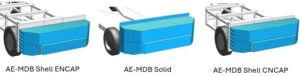
Arup Cellbond Barrier Models A range of robustly validated finite element models for LS-DYNA. AE-MDB Side Impact Barriers This barrier…
Arup Cellbond Barrier Models A range of robustly validated finite element models for LS-DYNA. Full Width Deformable Shell Barrier This…