

The Oasys LS-DYNA Environment introduces the new IIHS Spec 2 v 2.0 model

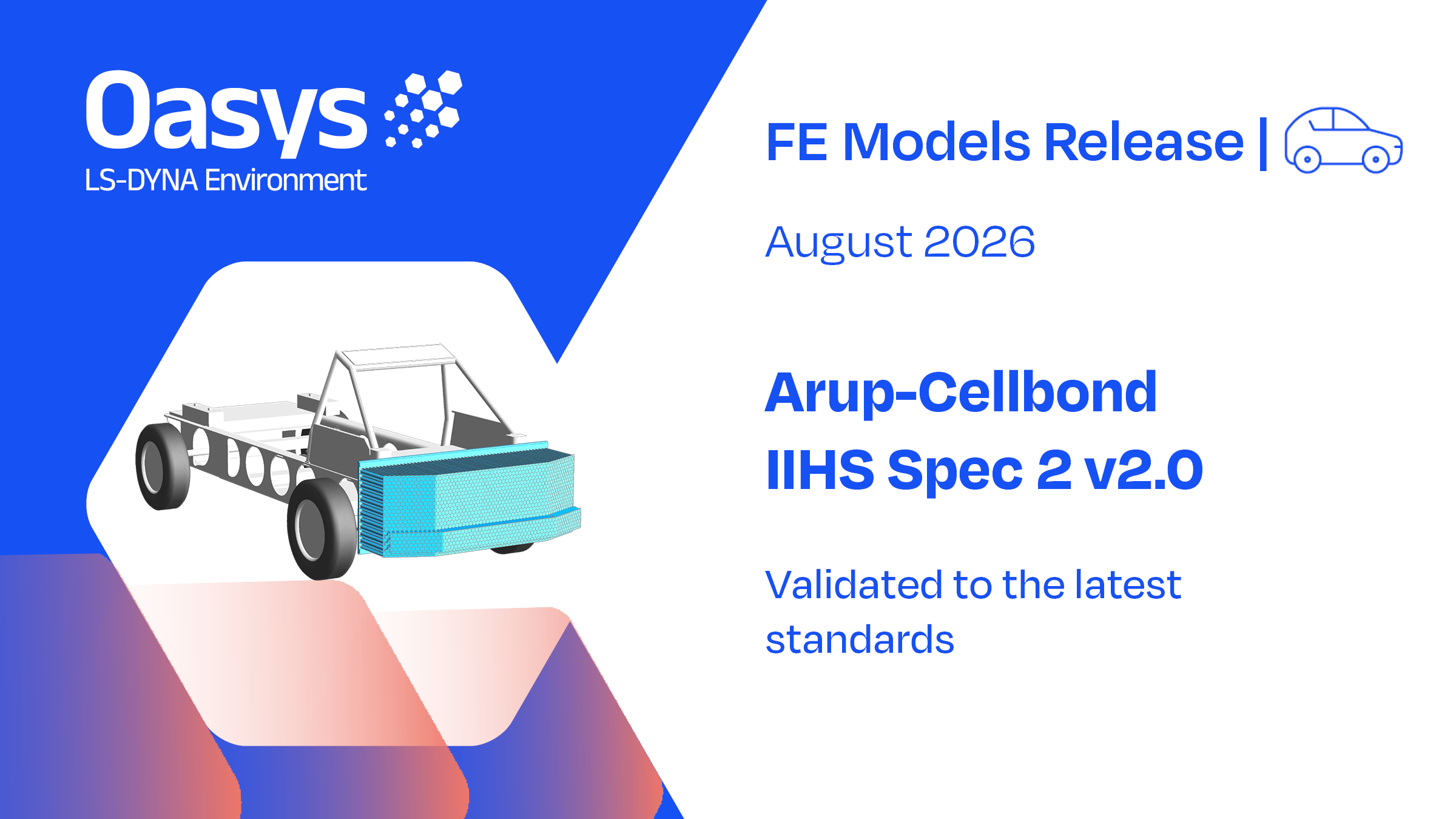
Arup-Cellbond IIHS Side Impact MDB Shell Model
For Side Impact Crashworthiness Evaluation 2.0 Crash Test Protocol, Version III, May 2025
The new IIHS Spec 2 v2.0 barrier represents a collaborative effort between leading organisations across the vehicle safety community. Building on more than 20 years of barrier development experience, we applied proven modelling techniques, refined through extensive collaboration with Cellbond, to create high-fidelity simulation models. Developed using the latest capabilities of Ansys LS-DYNA, these models provide robust, efficient, and accurate analysis to support barrier design and validation.
Cellbond led the physical barrier development and testing programme, while Arup and Oasys LS-DYNA Environment provided advanced simulation and engineering expertise.
Together with a major OEM, the team integrated virtual and physical validation approaches to help develop the next generation IIHS Spec2 barrier specification, ensuring a robust and representative assessment framework for modern electric vehicles.
Key updates in this release include:
- Arup-Cellbond IIHS Side Impact MDB v2.0 has been calibrated against two additional dynamic impact tests simulating barrier ride-over scenario
- Re-calibrated honeycomb block failure parameters for improved intrusion/energy absorption
- Updated adhesive bond strength for improved structural integrity
- Updated *CONTROL_SHELL for improved accuracy and model robustness
As vehicle designs evolve, particularly with the growing presence of battery electric vehicles (BEVs), new structural characteristics are emerging. Low ride heights and stiff underbody battery enclosures can lead to more localized and concentrated interactions during side impacts, which are not fully captured by traditional barrier validation setups.
To address this, Arup and Cellbond recently expanded the physical test program to include additional impact scenarios representing these localized loading conditions. Two new configurations were introduced to better reflect how modern vehicle structures interact with the barrier. These tests provided further insight into barrier deformation and load transfer behavior.
The MDB model has been updated using data from these additional tests, improving its ability to represent localized deformation while maintaining consistency with existing validation conditions. These enhancements extend the model’s applicability across a broader range of vehicle architectures and impact scenarios.
Overall, the updated barrier model continues to provide a reliable and industry-relevant foundation for side impact simulation, supporting more robust safety evaluation as vehicle designs continue to evolve.
Find out more about the technical specifications on the product page .
Licensing and Access to the FE Models
For current customers: please reach out to [email protected]
To request the updated models and licenses. A new license is required for each model, so please do get in touch.
We’re pleased to share updates to our FE models, ensuring our tools remain current and aligned with the latest industry regulations and standards.
Related News
-

-

Oasys 22.1 released
-
Revolutionising Roadside Brain Injury Assessment using Simulation Software